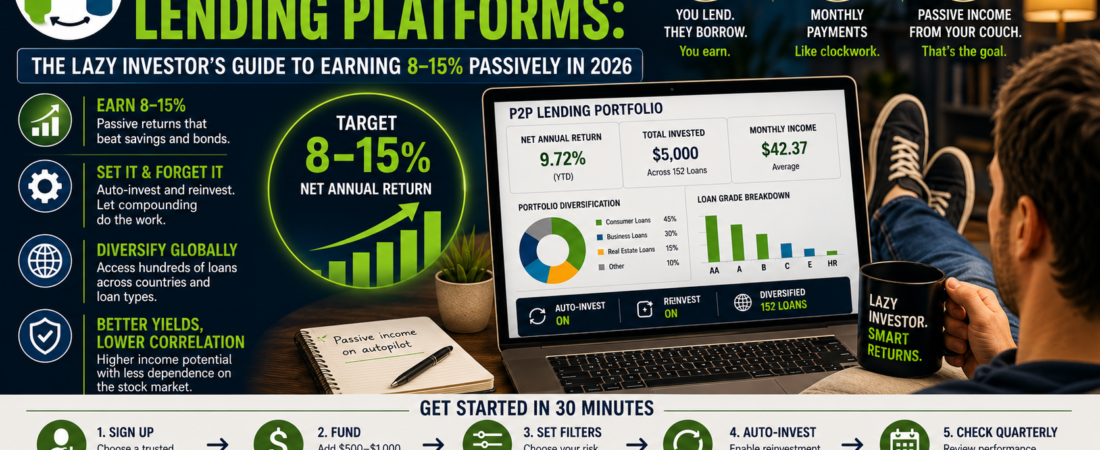
If your money is still parked in a high-yield savings account paying 4%, you’re leaving real money on the table. Peer-to-peer (P2P) lending lets you skip the bank, become the lender yourself, and pocket the interest that would normally line a bank’s profits. The best part? Once you set it up, the cash keeps flowing in while you do absolutely nothing — which is exactly the kind of income we like around here.
The global P2P lending market is projected to cross $700 billion by 2030, and the asset class has quietly matured into a legitimate alternative to bonds for income-focused investors. Here’s everything a lazy investor needs to know to get started in 2026.
What Is Peer-to-Peer Lending?
P2P lending is exactly what it sounds like: regular people lending money to other regular people (or to small businesses) through an online platform that handles all the paperwork, credit checks, and collections. Instead of putting your savings in a bank that loans it out at 12% and pays you 4%, you become the bank — and you keep most of the spread.
When a borrower applies for a loan on a P2P platform, the platform assigns them a risk grade based on credit score, income, debt-to-income ratio, and other factors. Investors then fund slices of those loans — sometimes as little as $25 per loan — and collect monthly principal and interest payments for the life of the loan, typically 24 to 60 months.
The model first appeared with Prosper in 2005 and LendingClub in 2006. After some rocky years and a wave of consolidation, the surviving platforms in 2026 are more regulated, more transparent, and frankly better than the wild-west early days.
Why P2P Lending Fits the Lazy Income Playbook
Three reasons this asset class deserves a spot in your passive income portfolio:
1. Automated reinvestment. Every major platform has an “auto-invest” feature. You set your risk tolerance, term length, and minimum interest rate, and the platform automatically deploys your interest payments into new loans. Compounding does the rest.
2. Higher yields than bonds. Consumer loans typically yield 4–8% net of defaults, business loans 7–12%, and real estate-backed loans 8–15% or more. Even a conservative diversified portfolio comfortably beats most fixed-income alternatives.
3. Low correlation with stocks. P2P returns don’t move in lockstep with the S&P 500. When markets get volatile, your monthly loan payments keep arriving like clockwork — useful diversification for anyone heavily weighted in equities.
The Best P2P Lending Platforms in 2026
The landscape has changed dramatically since the 2015 peak. Many platforms shut down their retail investor programs (LendingClub being the most notable). Here’s where individual investors can still play:
For U.S. Investors
Prosper is the last major American platform where retail investors can directly fund consumer loans. The note minimum is $25, and you can diversify across risk grades AA through HR. Historically, diversified Prosper portfolios have returned roughly 4–6% annually after defaults and fees — modest, but still beats most savings accounts with proper diversification.
Upstart uses AI-driven underwriting and considers factors like education and employment history beyond just credit score. It’s primarily a borrower-facing platform now, but its institutional investor program has expanded options for accredited investors.
Constitution Lending focuses on real estate-backed loans and has gained traction with U.S. investors seeking collateralized exposure.
For Global / European Investors
Mintos is the giant of European P2P. Rather than originating loans itself, it acts as a marketplace connecting investors to dozens of loan originators across multiple countries — meaning you can diversify across geographies and loan types with a single account. Its “Core” automated portfolios make beginner setup nearly effortless.
Income Marketplace and Debitum offer similar aggregator-style models with buyback guarantees from originators, which add a layer of protection if a borrower defaults.
PeerBerry, Robocash, and Twino round out the well-regarded European options, all with strong track records and auto-invest tools.
What Returns Should You Realistically Expect?
Be skeptical of platforms advertising 14–18% returns without context. Those are gross yields on the riskiest loan grades, before defaults and platform fees. After realistic default rates of 3–5% on Grade A loans and 10%+ on speculative grades, your net returns look very different.
Here’s a realistic 2026 expectation table for a diversified portfolio:
| Risk Profile | Loan Types | Net Annual Return |
|---|---|---|
| Conservative | Top-grade consumer | 4–6% |
| Moderate | Mixed consumer + business | 7–10% |
| Aggressive | Lower-grade + real estate bridge | 10–15% |
The right strategy for most lazy investors: target the moderate bucket, diversify across at least 100 loans, and never put more than 10–15% of your total portfolio into P2P.
The Risks You Need to Understand
P2P lending is not a savings account. Your money is not FDIC-insured. Three risks deserve respect:
Default risk. Borrowers stop paying. Diversification across hundreds of loans is the only real protection — never concentrate in a handful of notes.
Platform risk. If the platform itself goes bankrupt, recovery becomes complicated. Stick to platforms with at least five years of operating history, clear regulatory oversight (SEC in the U.S., ECSPR licensing in the EU), and audited financials.
Liquidity risk. Your money is locked up for the loan term. Some platforms have secondary markets where you can sell notes early, but you may have to accept a discount, especially during market stress.
How to Get Started in 30 Minutes
The lazy setup is straightforward:
- Pick one platform (Prosper for U.S. residents, Mintos for everyone else is the simplest starting combination).
- Open and fund an account with an amount you can lock up for 3+ years — $500 to $1,000 is a fine starting point.
- Set up auto-invest with a conservative or moderate filter. Look for filters that prioritize “years of credit history” and “debt-to-income ratio.”
- Enable automatic reinvestment of all interest payments.
- Set a calendar reminder to log in once a quarter to check on portfolio health and adjust filters if needed.
That’s it. The platform handles loan origination, payment processing, and collections. You handle… nothing.
The Bottom Line
P2P lending isn’t going to make you rich overnight, and it shouldn’t replace your stock index funds or emergency cash. But as a slice of a diversified passive income portfolio — say, 5–10% allocation — it offers a compelling yield premium over bonds with genuinely passive mechanics once configured.
In a world where finding 8–10% reliable yield is increasingly difficult, P2P lending remains one of the most accessible ways for an everyday investor to earn institutional-style returns from the comfort of their couch.
Start small, diversify aggressively, and let auto-invest do the heavy lifting. Your future self will thank you.
Disclaimer: This post is for informational purposes only and is not financial advice. P2P lending involves risk of loss. Do your own research and consider consulting a licensed financial advisor before investing.